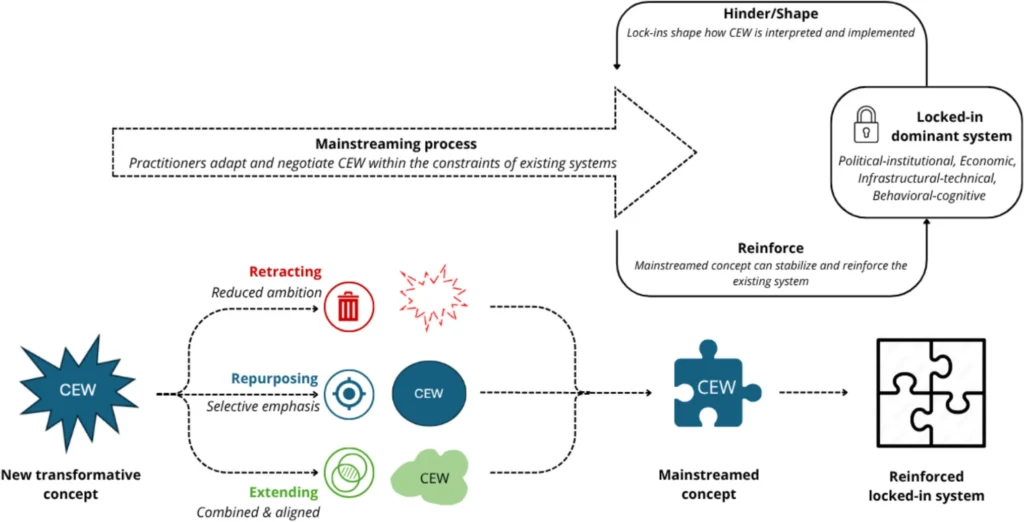
This paper examines how new policy concepts are taken up in practice, focusing on the Circular Economy of Water (CEW) in the Netherlands. Drawing on 20 semi-structured interviews with practitioners from different governance levels, regions, and sectors, we analyze how CEW is interpreted, reshaped, and mainstreamed into existing water-governance structures. We identify six lock-ins that constrain CEW’s implementation and three mechanisms through which it is mainstreamed. Our findings show that lock-ins and mainstreaming mechanisms are closely interconnected: While CEW adapts to existing systems, it can also reinforce them, at times leading to rebound effects or supporting business-as-usual practices. This study contributes to a deeper understanding of the dilemmas related to CEW governance, offering insights to enhance sustainable water management practices and transformative changes. We argue that design-oriented approaches can inform how CEW is imagined and implemented, helping to reconsider whether it addresses the causes of unsustainable practices or offers temporary fixes. Read more here: https://doi.org/10.1007/s13280-026-02429-4