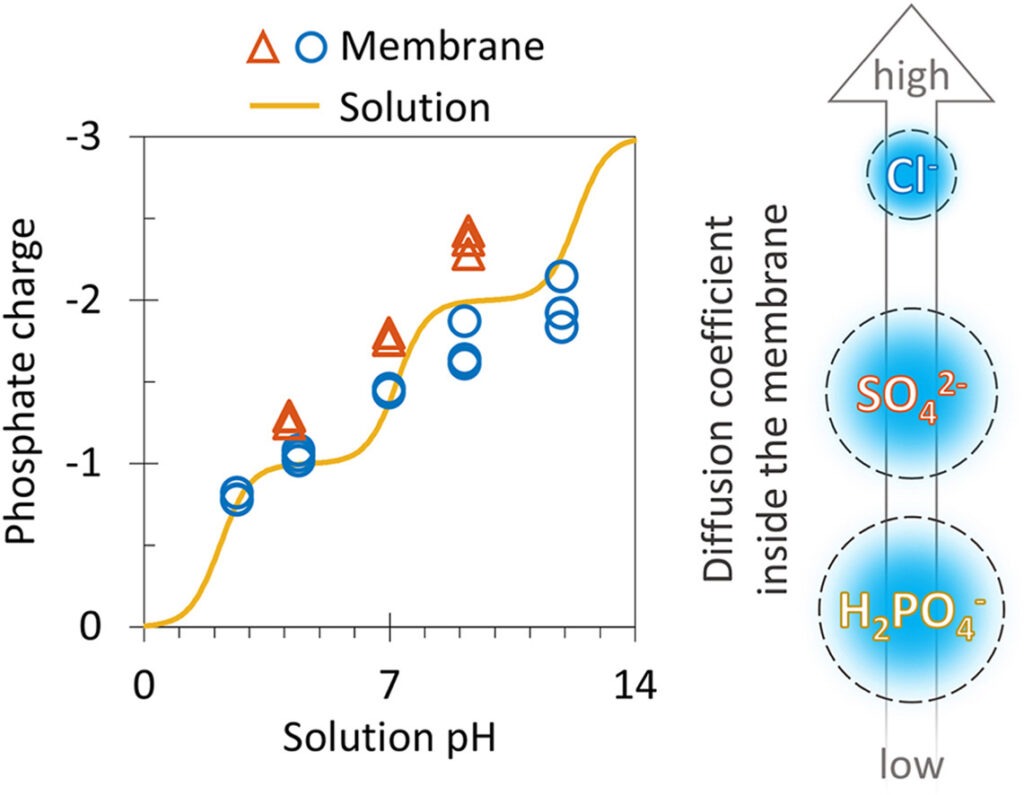
Phosphate recovery from wastewaters is a key strategy to overcome the limited accessibility to phosphate fertilizers. Understanding the phosphate transport across anion-exchange membranes (AEMs) is a crucial aspect to optimize the operation of electrochemical technologies, e.g., electrodialysis, to recover phosphates. The phosphate transport is influenced by the amphoteric nature of phosphates, i.e., the ability to accept or donate a proton. We equilibrated anion-exchange membranes in phosphate solutions of different pHs, and analyzed the phosphate charge inside the membranes as a function of the solution pH with which it was in contact. Furthermore, we characterized the electrochemical response of 6 different AEMs in phosphate solutions at pH 4.2 and 9.2. At pH 4.2, the monovalent phosphates, H2PO4−, are most prevalent within the membrane. The H2PO4− diffusion coefficient inside the membrane ranges between [2.6 – 72]۰10−12 m2/s with a strong dependency on the membrane water volume fraction (swelling). The anion diffusion coefficient trend inside the AEMs is Cl− > SO42− > H2PO4−. At pH 9.2, the effective phosphate charge inside AMVN is −2.0, while inside FAB it is −2.4. The FAB membrane resistance was relatively high in phosphate solution at pH 9.2 compared to the other AEMs, due to the low water volume fraction of the FAB membrane and the membrane affinity to phosphate ions of relatively high valencies. Read more here: https://doi.org/10.1016/j.memsci.2026.125882