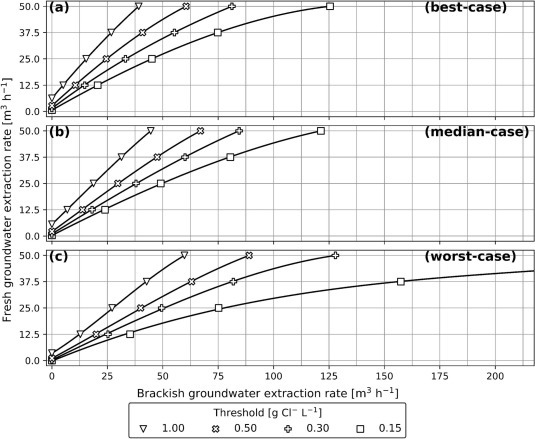
Scavenger wells offer effective strategies to combat freshwater scarcity and saltwater intrusion in coastal areas by simultaneously extracting fresh and brackish groundwater. This dual extraction intercepts brackish groundwater and limits saltwater upconing, enlarging fresh groundwater supplies and generating additional drinking water resources. While operational scavenger well strategies have been optimized by various approaches, high-resolution field-calibrated three-dimensional variable-density groundwater flow and coupled salt transport models have not yet been used to develop a methodology that optimizes these strategies and accounts for parameter uncertainty. This study calibrates such a numerical model with data from an intensively monitored scavenger well field study, capturing observed fresh groundwater downconing and saltwater upconing trends, though underestimating their magnitude. Through 30-year groundwater extraction scenarios, we develop a methodology that both optimizes these strategies while incorporating parameter uncertainty. We determine critical pumping curves that provide maximum allowable fresh groundwater extraction rates and associated minimum required brackish groundwater extraction rates including parameter uncertainty for various permissible chloride concentrations in the fresh groundwater extraction well screen. Results show brackish groundwater extractions can effectively mitigate saltwater upconing and increase maximum allowable freshwater pumping rates. Required ratios of brackish to fresh groundwater extraction to maintain a sustainable extraction depend on fresh groundwater extraction rates, permissible chloride concentrations and parameter settings. For a 30-year period of 1200 m3 d-1 freshwater extraction with a 0.30 g Cl– L-1 threshold, ratios of 1.6–2.6:1 are required. Critical pumping curves could serve as a tool to support operational strategies of scavenger wells in coastal aquifers. Read more here: https://doi.org/10.1016/j.jhydrol.2025.134554