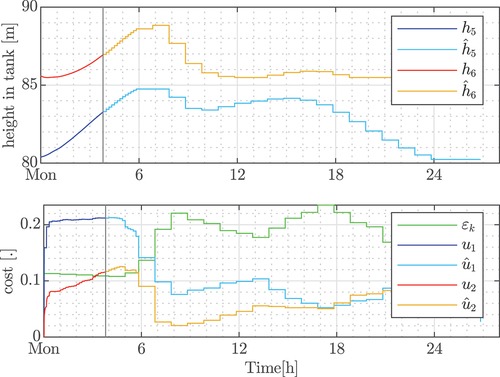
This paper considers the problem of demand prediction for Model Predictive Control (MPC) of drinking water distribution networks (WDNs). The goal is first to analyse how the quality of the demand prediction model affects the MPC control performance under different circumstances. Then, this knowledge is used to define design requirements of such a demand prediction models. The effects on MPC performance are split up into effects of short-term (0 h–2 h ahead) prediction accuracy and long-term (2 h–24 h ahead) prediction accuracy. The tests are performed with two generated demand prediction models with different structures. Furthermore, the MPC computation time can be drastically reduced by reducing the long-term prediction resolution, without sacrificing much of the MPC performance. In terms of reliability for MPC, it showed that the auto-regressive models structures outperform multi-layer perceptrons and recurrent neural networks when measured demand data suddenly and significantly changed from the historical daily pattern. Read more here: https://doi.org/10.1080/1573062X.2025.2512420