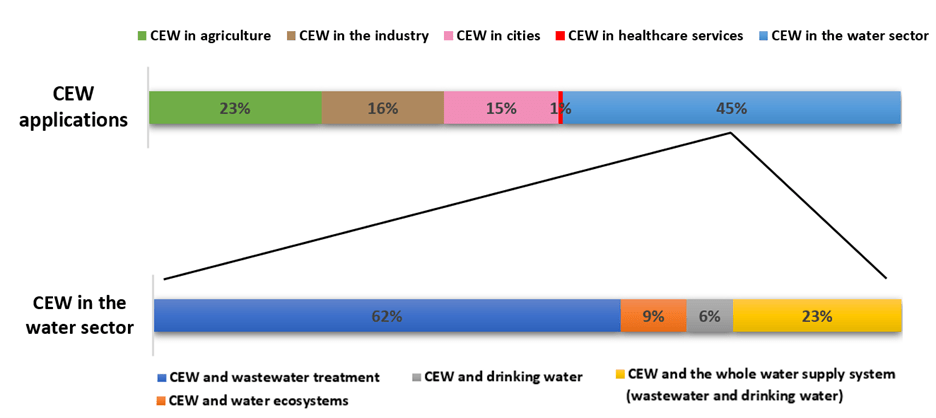
Although the concept of circular economy (CE) applied to the field of water (CEW) is relatively new, it offers a promising avenue to challenging water concerns and is increasingly proposed as the way forward in water policy and research. Literature often describes the governance of CEW as a challenge or barrier to CEW. However, the literature is spread across disciplines and areas, and work is required to condense the findings. Using a systematic literature review of 178 peer-reviewed articles, this research examines the governance of CEW to understand and explore key themes. By analyzing the literature through the lens of six governance dilemmas—cost and benefit, implementation and enforcement, level and scale, mode and instrument, problem perception, and timing and sequencing—the paper demonstrates that CEW is viewed in an often normative and static way. One way this takes place is by emphasizing the optimization of existing systems through water recycling, with less focus on decreasing consumption, which could require deeper fundamental and transformative changes. Also, the literature assumes and assigns roles unevenly: benefits are largely framed as accruing to private actors, whereas costs and responsibilities are disproportionately placed on the public sector and civil society. Finally, governance discussions tend to overlook how different frames (i.e., decreasing, optimizing, retaining) and applications of CEW (e.g., for agriculture, industry, or nature conservation) call for distinct governance responses. Finetuning proposed governance solutions to existing and specific framings and applications may offer insights into further developing CEW. Read more here: https://doi.org/10.5751/ES-16390-300336