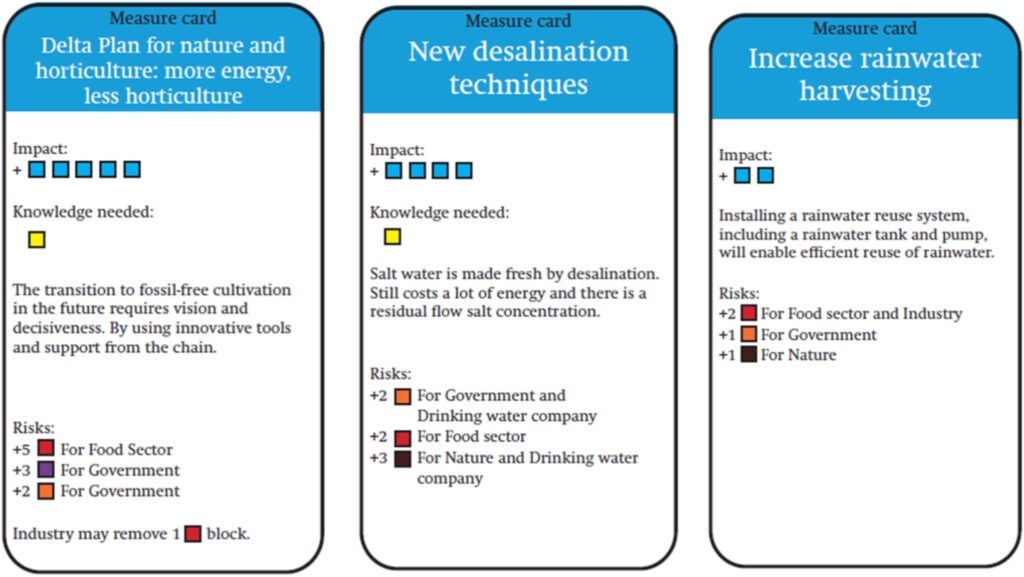
Serious games are increasingly used to engage stakeholders with complex social-ecological challenges and to support transformative learning. Their effectiveness depends on achieving a careful balance between play, reality, and meaning, ensuring that games are not only engaging and enjoyable (play), but also credible in their representation of real-world systems (reality), and capable of producing reflective, actionable insights (meaning). This study evaluates the design and performance of a serious game on future water supply in drought-prone regions of the Netherlands. The game translates Termeer et al. (2024)’s three governance transformation pathways: big plans, small wins, and rule change, into interactive decision options with actor-specific risks and interdependencies. By embedding governance theory directly within gameplay, the game enables players to experience and negotiate the tensions, trade-offs, and uncertainties inherent in transformation processes. While previous water-domain games have sought to reconcile play, reality, and meaning, few have systematically documented the iterative design and evaluation processes needed to sustain this balance. Guided by Triadic game design, the development process advanced through iterative cycles, each aimed at maintaining a productive balance of the three elements. The study makes two key contributions. First, it provides a concrete operationalisation of governance transformation pathways within game mechanics. Second, it provides a structured and empirically grounded assessment of balancing play, reality, and meaning in serious game design, serving as a guide for others. Together, these contributions enhance the methodological rigour and practical relevance of serious games as instruments for transformative water governance and other sustainability transitions. Read more here: https://doi.org/10.1016/j.jclepro.2025.147252