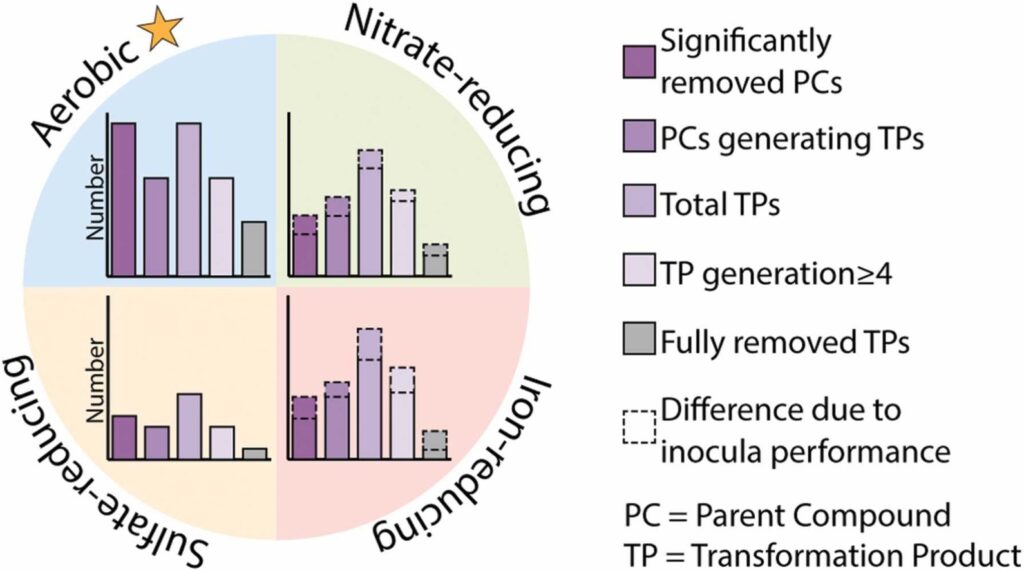
Redox conditions are key environmental factors influencing organic micropollutants (OMPs) biodegradation in both nature-based and engineered treatment systems. Yet, OMP biodegradation and transformation product (TP) formation under different redox conditions are not fully understood, particularly using natural inocula. Here, we tested two natural inocula, from soil and ditch sediment, for biodegradation of 19 OMPs under four redox conditions: aerobic, nitrate-reducing, iron-reducing, and sulfate-reducing. Target and non-target analyses results confirmed aerobic conditions as the most favourable, resulting in the removal of up to 14 OMPs and producing up to 14 TPs, while sulfate-reducing conditions were the least effective, with 7 OMPs biodegraded and 8 TPs produced, consistent with the redox ladder. Under nitrate- and iron-reducing conditions, OMP biodegradation and TP formation were also influenced by the inoculum source. While some OMPs were well-removed (e.g., paracetamol and hydrochlorothiazide) or persistent (e.g., diglyme and bentazon) under all tested conditions, the fate of most OMPs was redox-dependent in both rate and progress along the degradation pathway. Redox-specific TPs revealed different biodegradation pathways, likely steered by the influence of redox conditions on microbial community composition and activity, or inocula pre-exposure to specific redox conditions. Using prediction tools (Biowin, MS2Tox, and MS2Quant), we further evaluated the relative biodegradability and toxicity of TPs compared to their parent compounds (PCs), and estimated the PC-TPs bioconversion efficiency. Our results provide a more comprehensive view of OMP fate and TP formation across redox conditions. These insights can support the optimization of OMP removal strategies in engineered and natural redox-shifting systems. Read more here: https://doi.org/10.1016/j.jhazmat.2026.141775