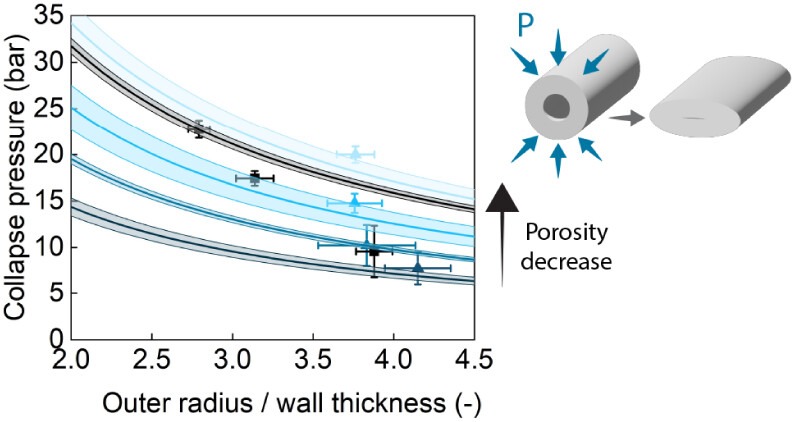
Pressure-driven hollow fiber (HF) membranes are often operated with the feed on the outside of the HF. In such a configuration, it is important to know the limits of the external pressure that can be applied to the membrane. Therefore, we investigated whether a model for predicting the collapse pressure of isotropic thin-walled cylinders was able to accurately predict the collapse pressure of outer-skinned HF membranes. Theoretical derivations showed that collapse can occur due to plastic or elastic failure, where, in the case of plastic failure, the collapse pressure should equal that of the burst pressure. Combining experimental results with our model revealed that for our membranes, plastic failure was the dominant failure mechanism. The model was able to accurately predict the influence of the membrane’s porosity on the collapse pressure. However, the model seemed to only partially predict the influence of different geometric dimensions of the HF on its collapse pressure. Interestingly, though, the results showed that, for 7 out of 8 HF membranes, the burst pressure was indeed similar to the collapse pressure, highlighting that the burst pressure can be used as an indicator for the collapse pressure of the outer-skinned HF membranes. This is an important finding for the field of HF membranes, as the burst pressure is much easier to experimentally determine than the collapse pressure. Additionally, the model provides a clear direction to further improve the collapse pressure. Read more here: https://doi.org/10.1021/acsaenm.6c00029