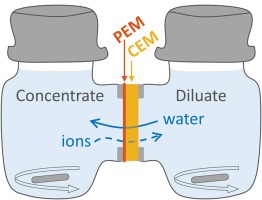
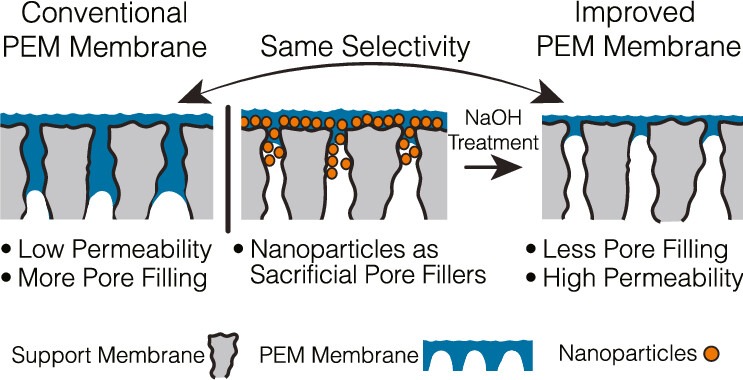
Ion-exchange membranes with high monovalent/divalent selectivity can accelerate the commercialization of electrochemical systems for circular economies. The membrane selectivity can be achieved by coating the membrane with a polyelectrolyte multilayer (PEM). The co-ion and water transport are critical aspects for using the coated cation-exchange membranes (CEMs) in bipolar membrane electrodialysis stacks (BMED) that utilize brine streams containing multivalent cations. In BMED, the CEM is needed to minimize the hydroxide and multivalent cation transport while facilitating the monovalent cation transport. We examined the ion and water transport across bare and coated CEMs in diffusion dialysis and electrodialysis. The CEMs were coated on one side with PAH/PSS multilayers, i.e., poly(allylamine) and poly(4-styrenesulfonate). During diffusion dialysis experiments, the ion flux across bare CEMs depends mainly on the type of anion, where OH− > Cl− > SO42−. Moreover, the ion diffusion coefficients inside a CEM were analyzed using a Nernst-Planck model fitted to the diffusion dialysis and membrane resistance. The cation mobility is less restricted than the anion mobility inside the FKB membrane, where the trend of diffusion coefficients is Na+ ≫ Mg2+, Cl− > SO42−. In PEM-coated membranes, the ion fluxes were sensitive to the coating orientation as well as the cation type. Furthermore, the PEM coating did not affect the osmotic transport of water across the coated CEMs. In other words, the water transport is limited by the permeance of the thick CEM rather than the thin PAH/PSS multilayer coating. Lastly, the effect of solution concentration on ion transport across PEM-coated membranes was examined considering the Donnan exclusion mechanism. Read more here: https://doi.org/10.1016/j.memsci.2025.125072